
Thrombophilia profile - 14 mutations
Thrombophilia profile – 14 mutations is a molecular genetic blood test that detects 14 inherited gene variants involved in blood clotting, clot breakdown, homocysteine metabolism, blood pressure regulation and fat metabolism. The result helps in assessing the risk of thrombosis and cardiovascular disease and in decisions about prevention.
Preparation and sampling
- Preparation
- Guide to preparing for tests
- Sample
- Blood
- Results available in
- 9 working days
- Where it is done
- All laboratories and map
Description
About the test
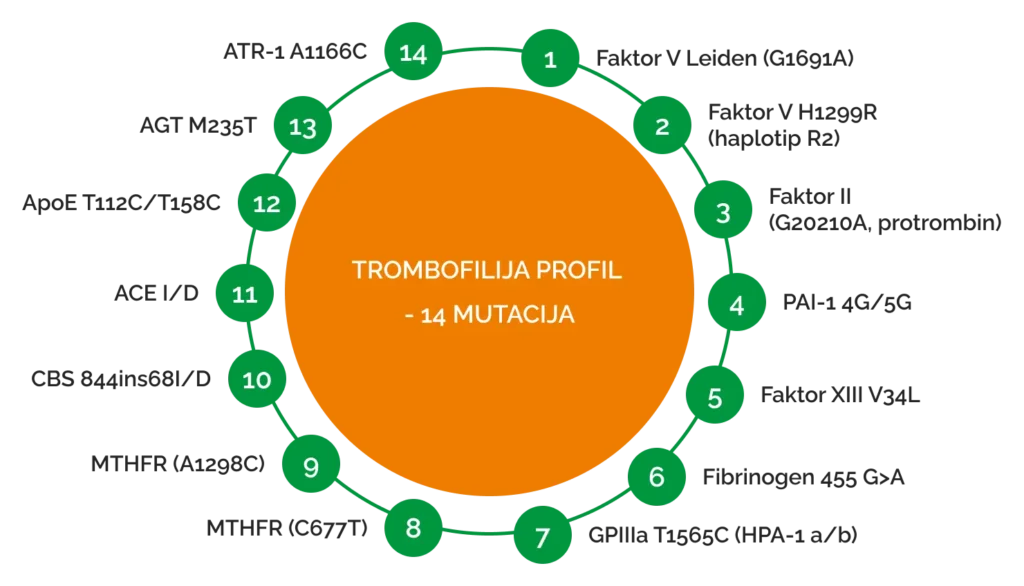
Thrombophilia profile – 14 mutations is a molecular genetic test that detects inherited variants in genes involved in blood clotting, clot breakdown (fibrinolysis), homocysteine metabolism, blood pressure regulation and fat metabolism. DNA is extracted from a blood sample and the variants are identified by a molecular method (PCR); for each variant the genotype is reported with a clinical interpretation. The test covers:
- Factor V Leiden (G1691A) – resistance to activated protein C; the most common inherited cause of thrombophilia and a recognised risk factor for venous thrombosis.
- Factor V H1299R (R2 haplotype) – a variant with a small effect on its own, which increases the risk when combined with factor V Leiden.
- Factor II (prothrombin G20210A) – higher prothrombin levels; the second most common inherited cause of thrombophilia.
- PAI-1 (4G/5G) – the 4G allele is linked to higher levels of plasminogen activator inhibitor-1 and weaker clot breakdown.
- Factor XIII (V34L) – affects the stabilisation of the fibrin network of the clot; its effect depends on the other variants present.
- β-fibrinogen (-455G/A) – a variant linked to higher fibrinogen levels in the blood.
- GPIIIa (T1565C, HPA-1a/b) – a variant of the gene for part of the platelet receptor that binds fibrinogen (GP IIb/IIIa); studied as a marker of susceptibility to arterial thrombosis.
- MTHFR (C677T) – reduced activity of an enzyme of folic acid metabolism; it can lead to raised homocysteine, especially with folate deficiency.
- MTHFR (A1298C) – a milder effect; in combination with C677T it can contribute to raised homocysteine.
- CBS (844ins68) – an insertion in the gene for cystathionine beta-synthase, an enzyme involved in breaking down homocysteine.
- ACE (I/D) – an insertion/deletion in the gene for angiotensin-converting enzyme; the D allele is linked to higher activity of the enzyme, which is involved in blood pressure regulation.
- AGT (M235T) – an angiotensinogen variant linked to higher angiotensinogen levels and a tendency to high blood pressure.
- AGTR1 (ATR-1, A1166C) – a variant of the angiotensin II type 1 receptor, linked to a tendency to high blood pressure.
- ApoE (C112R and R158C) – determine the ε2, ε3 and ε4 alleles of apolipoprotein E, which influence blood fat metabolism and cardiovascular risk; the ε4 allele is also linked to a higher risk of Alzheimer's disease in later life, which is worth discussing with your doctor before testing.
The risk of thrombosis and cardiovascular disease rarely depends on a single variant. That is why, in one test, the profile covers variants affecting blood clotting and platelet function, clot breakdown, homocysteine levels, the renin-angiotensin system that regulates blood pressure, and fat metabolism, giving a broader picture of inherited susceptibility than individual tests. The genetic result does not change during life, so the test only needs to be done once; it is interpreted together with blood clotting tests and the lipid profile.
When it is recommended
- people who themselves, or whose relatives, have had venous thromboembolism (deep vein thrombosis, pulmonary embolism) or an arterial thrombosis;
- people with several risk factors (high blood fats, obesity, smoking, diabetes), before starting hormone treatment or before major surgery;
- women with repeated pregnancy losses or other pregnancy complications;
- first-degree relatives of people with confirmed variants that increase the tendency to thrombosis.
Preparation
- You do not need to fast, and the sample can be taken at any time of day.
- Do not stop your medicines, including anticoagulant treatment.
Sample
Venous blood (EDTA tube), from which DNA is extracted.
Interpreting the results
For each variant, the genotype is reported – normal (no variant), heterozygous (variant on one copy of the gene) or homozygous (variant on both copies) – with a clinical interpretation.
- Factor V Leiden and prothrombin G20210A are recognised genetic risk factors for venous thrombosis; their significance is assessed together with age, other illnesses and circumstances such as pregnancy, surgery or hormone treatment.
- Variants of MTHFR, PAI-1, factor XIII, ACE, AGT, AGTR1, β-fibrinogen and GPIIIa are susceptibility markers; their significance depends on other factors, and on their own they do not confirm inherited thrombophilia.
- International guidelines do not recommend MTHFR testing to assess the risk of venous thrombosis, and it is not used to decide on anticoagulant treatment.
- The profile detects only the listed variants; other, rarer changes can go undetected, and it does not cover protein C, protein S or antithrombin deficiency or antiphospholipid syndrome.
- If variants of greater significance are found (for example factor V, factor II or ApoE), genetic counselling and, if needed, testing of relatives are helpful. The reason for testing and the interpretation are best discussed with a haematologist or geneticist.
Your doctor interprets the result together with your symptoms and other findings.
What can affect the result
- Medicines and your current condition – anticoagulant treatment, a recent thrombosis, pregnancy or hormone treatment do not change the genetic result, unlike blood clotting tests.
- Bone marrow or blood stem cell transplant – the DNA in your blood then comes from the donor, so the result does not reflect your inherited variants; tell the laboratory before the sample is taken.
Related tests
- protein C, protein S and antithrombin III;
- lupus anticoagulant and antiphospholipid antibodies (anticardiolipin and anti-beta-2-glycoprotein I antibodies);
- homocysteine;
- lipid profile;
- full blood count and D-dimer;
- genetic counselling or a haematology consultation.
Frequently ordered together
How to order tests online?
Choose the tests you need and add them to your cart. Use the site search to find the tests you want more easily.
Payment method:
- Online – payment uses 3D-Secure, a secure authentication protocol that minimises the risk of fraud.
- At the laboratory – order your tests online and pay for them when you come to the laboratory.
After payment, you will receive an email confirming your order, with details of how to prepare for sampling. From then on, you can go to the Sante laboratory you chose when ordering your tests and have your samples taken.


